


21 October, 2026
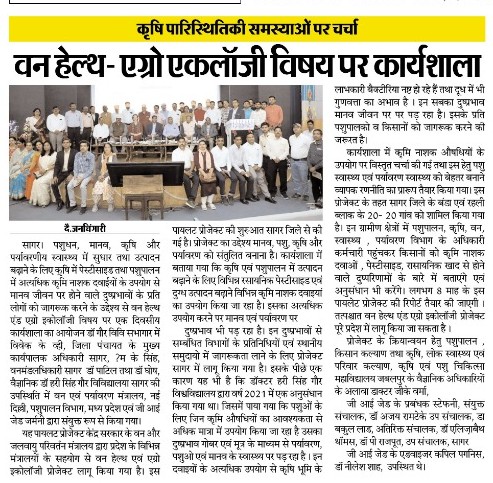
Translation in English
Workshop on the subject of One Health-Agroecology Sagar, Madhya Pradesh
To improve livestock, human, agricultural, and environmental health and to enhance production, a one day workshop on One Health and Agroecology was jointly organised by the Ministry of Environment, Forest and Climate Change, New Delhi, the Animal Husbandry Department, Madhya Pradesh, and GIZ at the Dr. Hari Singh Gour University auditorium, Sagar. The workshop was held in the presence of Vivek K., Chief Executive Officer, District Panchayat Sagar; M.K. Singh, Divisional Forest Officer, Sagar; Dr. Patil and Dr. Ghosh, Scientists; and faculty of Dr. Hari Singh Gour University, Sagar. The objective was to raise awareness about the harmful effects of excessive pesticide use in agriculture and overuse of deworming medicines in animal husbandry on human life and the environment.
This pilot One Health and Agroecology Project, initiated by the Central Government’s Ministry of Environment, Forest and Climate Change in collaboration with state departments, has been launched in Sagar district. The aim is to create balance between human health, livestock management, and the environment.
It was highlighted during the workshop that chemical pesticides are being widely used to boost agricultural production, while excessive deworming medicines are being administered to livestock to increase milk yield. Such practices are adversely impacting human health, soil quality, and the environment. Research conducted by Dr. Hari Singh Gour University in 2021 revealed that overuse of deworming medicines affects the environment through animal dung and urine, harming beneficial soil bacteria, degrading farmland, and reducing milk quality—all of which directly impact human well-being.
To address these concerns, the project seeks to raise awareness among departmental representatives and local communities. A detailed discussion on the use of deworming medicines was held in the workshop, and a comprehensive strategy was drafted to safeguard both animal and environmental health.
Under this pilot initiative, 20 villages each from Banta and Rahli blocks of Sagar district have been selected. Field staff from the Animal Husbandry, Agriculture, Forest, Health, and Environment departments will regularly visit these villages to educate farmers on the ill effects of deworming medicines, pesticides, and chemical fertilizers, while also conducting field research. The pilot will run for about eight months, after which a detailed report will be prepared. Based on its outcomes, the One Health and Agroecology Project will be scaled up across Madhya Pradesh.
The workshop was also attended by scientific officers and representatives from various institutions including Animal Husbandry, Farmer Welfare and Agriculture, Public Health and Family Welfare, and the College of Agriculture and Animal Husbandry, Jabalpur. Key participants included Dr. G.K. Verma; Dr Stefanie Preuss, GIZ Manager; Joint Director Dr. Ajay Ramteke; Deputy Director Dr. Bakul Lad; Additional Director Dr. Elizabeth; Dr. P. Rajput, Deputy Director Sagar; Kapil Pagnis, Advisor, GIZ; and Dr. Nilesh Shah.
© 2014 IGBP. All Rights Reserved.
Site By: Virtualpages
